
 日本語
日本語 eci
eci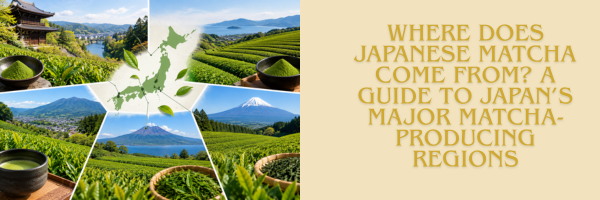
Where was the matcha produced?
Japan has several major tea-producing regions, and each has its own history, climate, cultivation methods, tea cultivars, and production characteristics.
You may already recognize famous names such as Uji, Nishio, Yame, Kagoshima, and Shizuoka.
But which region is right for your product?
In this guide, we introduce some of Japan’s major matcha-producing regions and explain what international buyers should consider when choosing an origin.
First, What Is Matcha?
Matcha is not simply ordinary green tea ground into powder.
The raw material used to produce traditional matcha is called tencha.
Tea plants intended for tencha are shaded before harvest. After harvesting, the leaves are steamed and dried without the rolling process normally used for sencha. The stems and veins are then removed, and the resulting tencha is finely ground to produce matcha.
This shading process helps create the characteristic umami, aroma, color, and relatively low astringency associated with matcha.
Where the tea is grown is only one part of its final quality. Cultivar, harvest season, shading, cultivation, processing, blending, and storage can all influence the finished matcha.
For this reason, origin should be considered together with the specifications required for your product.
| Region | Prefecture | Key Characteristics | Recommended For |
|---|---|---|---|
| Uji | Kyoto | One of Japan’s most famous tea-producing areas, with a long history of shaded tea production. Often associated with refined aroma, rich umami, smoothness, and premium positioning. | Premium retail matcha, ceremonial-style products, luxury gifts, specialty tea brands |
| Nishio | Aichi | A historic tencha and matcha-producing area. Known for deep green color, elegant aroma, and a mild, balanced flavor profile. | Retail matcha, cafés, beverages, confectionery, premium Japanese tea products |
| Yame | Fukuoka | A highly regarded tea-producing region in Kyushu, especially famous for shaded teas. Matcha from the region may offer rich umami, pleasant sweetness, and a smooth taste. | Premium matcha, specialty tea brands, high-end retail, products emphasizing umami |
| Kagoshima | Kagoshima | A major modern tea-producing region with a warm climate, early harvest season, and a wide range of cultivars. Strong potential for volume, organic options, and flexible sourcing. | Retail matcha, organic products, cafés, lattes, confectionery, food manufacturing, larger-volume sourcing |
| Shizuoka | Shizuoka | One of Japan’s largest and best-known tea-producing prefectures. Tencha and matcha production has expanded, offering a wide range of specifications and sourcing options. | Retail matcha, cafés, beverages, confectionery, food manufacturing, flexible commercial sourcing |
Single-Origin vs. Blended Matcha
Buyers also do not necessarily need to limit themselves to one production region.
Single-origin matcha can be attractive when the origin itself is an important part of the product’s identity.
For example, highlighting Kyoto, Yame, Kagoshima, or another origin can create a clear story for consumers.
However, requiring one specific origin can sometimes limit available quantity or increase the price.
Blended matcha can provide greater sourcing flexibility.
By selecting and blending suitable teas, it may be possible to achieve a desired balance of:
- Flavor
- Umami
- Color
- Aroma
- Price
- Quantity
- Consistency
This can be particularly useful for commercial buyers requiring stable volumes.
Single-origin is not automatically superior to blended matcha.
The right choice depends on your business.
Find the Right Japanese Matcha for Your Market
Japan produces matcha in many different regions, and each has its own history and characteristics.
But choosing matcha should not simply be about selecting the most famous place name.
The right matcha is the one that fits your product, customers, price range, required quantity, and business strategy.
Whether you are looking for premium first-harvest matcha from a specific region, organic matcha for retail, or a stable-volume blend for cafés and food manufacturing, ECI can discuss your requirements and explore suitable options from Japan.
Tell us the origin, quality, quantity, certification, application, and target price you are looking for — or simply tell us what kind of product you want to create.
We will help you explore the right Japanese matcha for your market.
Contact ECI Co., Ltd. to discuss your Japanese matcha sourcing requirements.

![TOKUTOKUYA News vol.27 [June, 2020]](https://eci-japan.com/en/wp-content/uploads/sites/5/2020/06/f2422a6e4299609a1b1cf3b3fcaf9282.jpg)
![TOKUTOKUYA News vol.25 [August, 2019]](https://eci-japan.com/en/wp-content/uploads/sites/5/2019/09/8-1.jpg)