
 日本語
日本語 eci
eci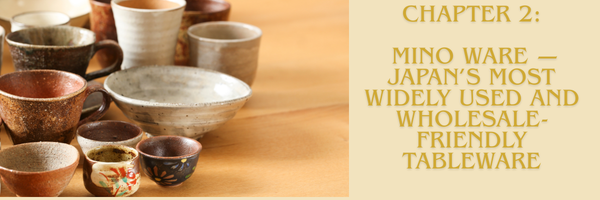
Introduction
Mino Ware is one of Japan’s most widely produced and distributed ceramic styles. Developed mainly in the Tono region of Gifu Prefecture, Mino Ware has evolved over centuries while continuously adapting to changing market needs.
Its greatest strengths lie in its design diversity and stable supply capacity. For wholesale and export businesses, flexibility in pricing, scalable production, and coordinated series development make Mino Ware highly suitable for international buyers.
History and Development
The history of Mino Ware dates back to the Momoyama period, when distinctive styles such as Shino and Oribe were developed.
Over time, Mino Ware expanded into large-scale production for everyday tableware. Today, it accounts for a significant share of Japan’s ceramic production.
This balance between tradition and production efficiency is what makes Mino Ware unique. It offers everything from refined, high-end aesthetics to simple and practical daily-use designs.
Design Diversity
Mino Ware is not limited to a single aesthetic.
- Traditional Japanese earthy tones
- Clean and modern white porcelain
- Hand-painted decorative patterns
- Minimal designs compatible with Scandinavian-style interiors
Because of this diversity, it is easy to tailor product selections to different markets and consumer preferences.
In overseas markets, Mino Ware aligns particularly well with categories such as “Japanese modern,” “natural living,” and “minimal lifestyle.”
Why Mino Ware Is Suitable for Wholesale
For international buyers, Mino Ware offers several commercial advantages:
- Stable and continuous production capacity
- Wide range of price options
- Easy coordination within the same series
- Suitable for both retail and food-service industries
The ability to offer coordinated sets—plates, bowls, mugs, and more—makes it easier for retailers to create cohesive shelf displays and branded assortments.
Popular Items in Global Markets
Among Mino Ware products, the following items are especially popular overseas:
- Dinner plates
- Soup and salad bowls
- Donburi bowls
- Mugs
- Small plate sets
Deep bowls and donburi bowls are particularly versatile, suitable not only for Japanese cuisine but also for pasta, salads, and fusion dishes—making them attractive to a wide audience.
Conclusion
Mino Ware represents a perfect balance between Japanese tradition and modern production capability. With stable supply and diverse design options, it is one of the most practical ceramic categories for wholesale and export markets.
When introducing Japanese ceramics to overseas markets, Mino Ware is one of the most strategic and reliable starting points.
In the next chapter, we will explore Hasami Ware, known for its minimalist and contemporary appeal.

![TOKUTOKUYA News vol.27 [June, 2020]](https://eci-japan.com/en/wp-content/uploads/sites/5/2020/06/f2422a6e4299609a1b1cf3b3fcaf9282.jpg)
![TOKUTOKUYA News vol.25 [August, 2019]](https://eci-japan.com/en/wp-content/uploads/sites/5/2019/09/8-1.jpg)

![TOKUTOKUYA News Vol.7 [February, 2018]](https://eci-japan.com/en/wp-content/uploads/sites/5/2018/02/f97e49c1fb8fa90b46309c0067f939d6.jpg)